Short answer: On a computer, open the folder you want to clear (or search for the emails you want gone), tick the Select box above the messages, click the link in the banner that says Select all [number] conversations, then click Delete. Search first if you only want some emails gone, for example older_than:1y, category:promotions or from: a sender. In the Gmail app on Android, iPhone and iPad, Select all takes 50 emails at a time, so big cleanups are faster on a computer. Deleted mail stays in Trash for 30 days and keeps using your storage until it leaves Trash.
Below are the steps for each device, the searches that pick out the right emails, what deleting does to your storage, and how to stop the clutter coming back. For everything else about Gmail, see our complete guide to Gmail.
How to mass delete emails on Gmail (computer)
- Open Gmail in a browser on your computer.
- On the left, open the place you want to clear: Inbox, a tab such as Promotions, a label, or All Mail for everything. Or type a search (see the next section).
- At the top left, above the messages, tick the Select box. This selects every conversation on the current page, and only that page.
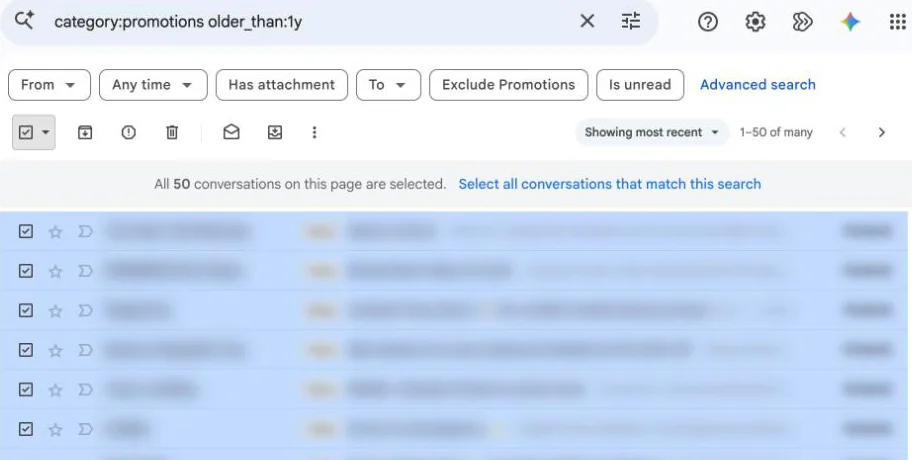
- A banner appears above the list, for example "All 50 conversations on this page are selected." Click the link next to it: Select all [number] conversations in [folder], or Select all conversations that match this search if you searched.
- At the top, click Delete (the trash can icon). If Gmail asks you to confirm a bulk action, click OK.
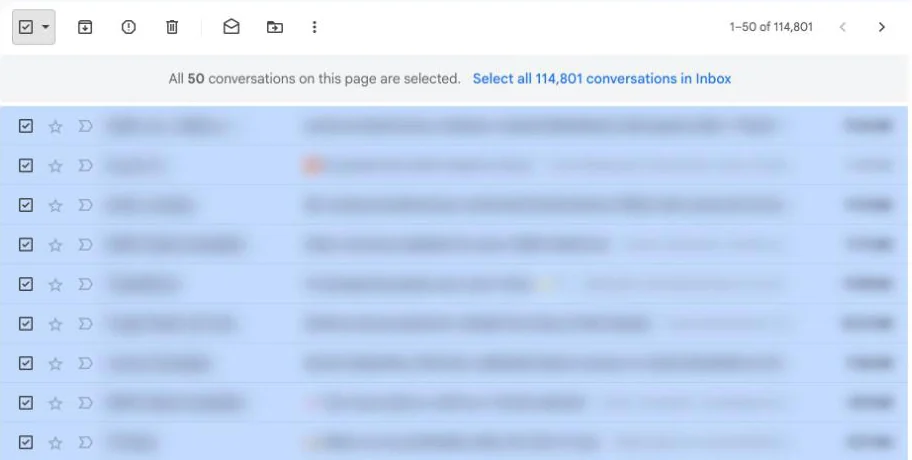
The banner link only shows up when there's more than one page of results. If everything fits on one page, the Select box has already selected it all.
Delete every email in your account
Open All Mail and follow the steps above. All Mail includes archived mail and the emails you sent, which clearing only the Inbox would leave behind. Gmail keeps one copy of each email, so this also removes it from every label. Spam and Trash aren't part of All Mail; you clear those separately (see below).
If you want to get rid of the Gmail address itself, not just its emails, that's a different job: see how to delete a Gmail account.
Faster with keyboard shortcuts
Turn shortcuts on first: Settings > See all settings > General, select Keyboard shortcuts on, then Save Changes. After that, press * then a to select all conversations on the page, and # to delete them. You still need the banner link to go past the first page.
Search first to delete only the emails you want
Deleting everything is rarely the goal. Type a search in the box at the top, press Enter, then run the same select-all steps on the results. These operators come from Google's own list:
| To delete | Type in the search box |
|---|---|
| Everything from one sender | from:news@example.com |
| Mail older than a year | older_than:1y (or 6m, 30d) |
| Mail before a date | before:2024/01/01 |
| A date range | after:2022/01/01 before:2023/01/01 |
| Promotions or social emails | category:promotions or category:social |
| Unread mail | is:unread |
| Big emails | larger:10M |
| Emails with attachments | has:attachment (or filename:pdf) |
| Mailing-list emails | list:info@example.com |
| Everything except starred mail | -is:starred |
You can combine operators in one search. A space means "and", OR means either one, and a minus sign leaves something out. Some combinations that work well:
- category:promotions older_than:6m finds promotions older than six months.
- is:unread older_than:1y finds a year's worth of mail you never opened.
- from:shop@example.com OR from:deals@example.com finds two senders at once.
- older_than:2y -is:starred -is:important finds old mail but skips what you starred or Gmail marked important.
Scroll through the results before you delete. Google notes that a minus search such as -is:starred can still return a conversation if just one message in it matches, so a starred email can hide inside a result.
Delete old emails
Search older_than:1y (or 2y, 5y) to find everything older than that, or before:2024/01/01 for a fixed date. Gmail accepts dates as year/month/day or month/day/year.
Delete all promotions
If your inbox uses tabs, click the Promotions tab and select all. Searching category:promotions also works. The same goes for category:social, category:updates and category:forums.
Delete all emails from one sender
Search from: plus the address, or part of it (for example from:linkedin.com). Select all and delete. To stop that sender for good, unsubscribe or set up a filter, both covered below.
Delete all unread emails
Search is:unread, select all and delete. To keep recent mail, try is:unread older_than:3m instead. If you'd rather keep them and just clear the unread count, select them the same way and click Mark as read.
Delete big emails to free up storage
Search larger:10M, or use the examples Google gives: has:attachment larger:10M, filename:pdf larger:5M and older_than:2y has:attachment. A handful of large attachments often frees more space than thousands of plain newsletters.
How to delete multiple emails in the Gmail app (Android, iPhone, iPad)
The Gmail app has a Select all box, but it takes 50 emails at a time, and there's no "select all that match this search" link like on the web.
- Open the Gmail app and touch and hold one message to start selecting.
- Tap other emails to add them one by one, or tap the box next to Select all at the top left. Gmail selects up to 50 messages.
- Tap Delete at the top.
- For the next 50, scroll to the top and tap the Select all box again.
Search works in the app too. Type from: a sender or has:attachment and delete the results 50 at a time. That's fine for a few hundred emails. For thousands, use Gmail on a computer.
If you delete one message at a time, set up a swipe:
- Android: Menu > Settings > General settings > Swipe actions. Next to Right swipe or Left swipe, tap Change, then Delete.
- iPhone and iPad: Menu > Settings > Inbox customizations > Mail swipe actions. Choose Right swipe or Left swipe, then Trash.
Other email apps handle bulk deletes their own way. Disclosure: we make Canary Mail. Canary works with Gmail on Mac, iPhone, iPad, Android and Windows. Its Bulk Cleaner picks out unimportant emails as you scroll, and you then delete or archive them in one go. The cleaner is on the paid Growth plan ($36 a year); one-click unsubscribe is on the free plan.
Empty Trash and Spam in Gmail
Deleting moves emails to Trash. They stay there for 30 days, then Gmail deletes them for good. Emails in Spam are also deleted permanently after 30 days. To clear either folder sooner:
- Trash on a computer: on the left, click More > Trash, then Empty Trash now in the banner at the top. To remove only some messages, tick them and click Delete forever.
- Spam on a computer: click More > Spam, then Delete all spam messages now.
- Trash in the app (Android, iPhone, iPad): tap Menu > Trash, then Empty trash now at the top.
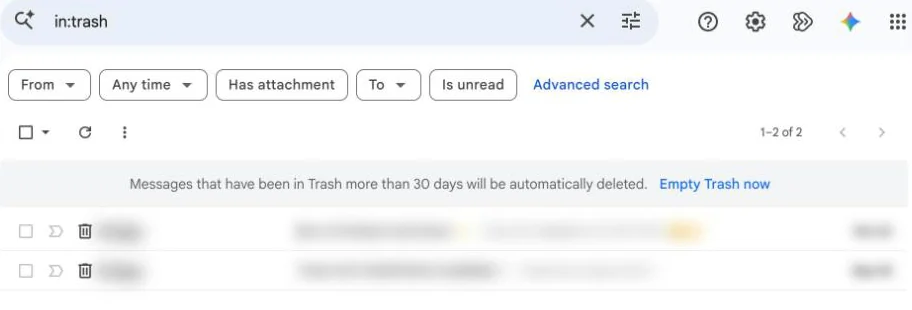
Once you empty Trash, or after 30 days, those emails are gone. Deleted drafts can't be recovered from Trash at all.
Deleted something by mistake? Within 30 days, open Trash, tick the messages, click Move to and pick Inbox or a label. In the app, touch and hold the message, tap More, then Move to (Move on iPhone and iPad).
What deleting does to your Gmail storage
Every Google Account includes up to 15 GB of storage, shared between Gmail, Google Drive and Google Photos. Gmail messages and attachments count toward it, and so does whatever is sitting in Spam and Trash. A mass delete only frees space once those emails leave Trash, after 30 days or when you empty it.
- The number won't change straight away. Google says storage can take up to 48 to 72 hours to update after you delete a lot at once.
- Gmail may not be what's filling it. Large Drive files and Photos backups use the same 15 GB, so check those if deleting email barely moves the total.
- A full account stops your email. At the limit, you can't send or receive Gmail, and messages sent to you bounce back to the sender. If you stay over the limit for 2 years, Google may delete content across Gmail, Drive and Photos.
Stop the clutter coming back
A mass delete clears the backlog, but new mail keeps arriving. Three things help.
Unsubscribe
Gmail is rolling out Manage subscriptions, a page that lists your active subscriptions and how many emails each sender has sent recently. On a computer, click More > Manage subscriptions on the left; in the app, tap Menu > Manage subscriptions. Then click Unsubscribe next to a sender. You may not have it yet, and a sender can take a few days to stop. Our guide on how to unsubscribe from emails on Gmail covers the other ways.
Create a filter that deletes emails automatically
- On a computer, click Show search options in the search box at the top.
- Enter the sender, words or other details. Click Search to check what matches.
- Click Create filter.
- Tick Delete it. To clear the matching emails you already have as well, tick Also apply filter to matching conversations.
- Click Create filter again.
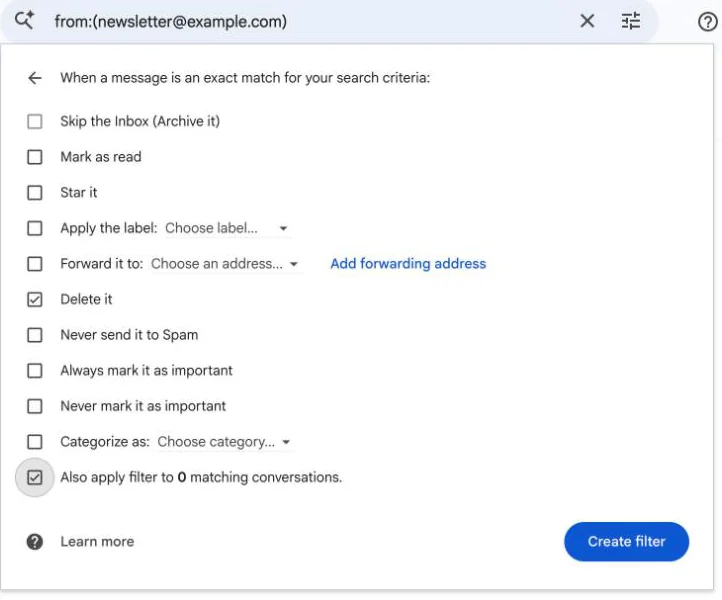
You create filters on a computer, and they act on mail as it arrives. That means a filter with older_than:1y won't keep deleting mail as it ages. Gmail has no "delete after X days" setting, so run your cleanup search again every few months. To change or remove a filter later, go to Settings > See all settings > Filters and Blocked Addresses. Our guide to creating rules in Gmail goes through more filter options.
Archive instead of deleting
Not sure you'll never need an email? Archive it. Archiving takes it out of the inbox but keeps it in All Mail and in search results. It still uses storage. Here's how archiving works in Gmail and how to find archived emails.
Why mass delete isn't working in Gmail
- Only one page of emails was deleted. You ticked the Select box but didn't click the Select all [number] conversations link. It appears just above the list after you tick Select.
- There's no select-all link on your phone. The app doesn't have one. Use Select all 50 at a time, or switch to a computer.
- Emails you wanted to keep disappeared. With conversation view on, deleting a conversation deletes every message in it, your replies included. To remove one message, open the conversation, click More next to Reply and choose Delete this message.
- Emails vanished on your other devices. Gmail keeps one copy of each email, so deleting it on your phone deletes it on the web and in every app signed in to that account.
- Storage still looks full. Empty Trash and Spam, then give it up to 72 hours.
- You deleted a sent email, but the other person still has it. Deleting only removes your copy. See whether you can delete an email you sent.
For more on settings, filters and fixes, head back to our complete guide to Gmail.
Frequently asked questions
How do I delete thousands of emails in Gmail at once?
On a computer, open the folder or search results, tick the Select box above the messages, click the "Select all [number] conversations" link in the banner, then click Delete. It works for any number of conversations. The app only does 50 at a time.
How do I delete more than 50 emails in Gmail on my phone?
In the Gmail app, tap Select all, delete the 50 selected emails, then scroll to the top and tap Select all again. Repeat for each batch. For thousands of emails, use Gmail on a computer, where one link selects everything.
Is there a way to delete all emails in Gmail?
Yes. On a computer, open All Mail, tick the Select box, click "Select all [number] conversations in All Mail" and click Delete. Then empty Trash if you want the space back straight away.
How do I delete 10,000 unread emails in Gmail?
Search for is:unread, tick the Select box, click the link to select all conversations that match the search, then click Delete. Add older_than:3m or category:promotions to delete only older or promotional unread mail.
Does Gmail automatically delete old emails?
Not in your inbox or archive. Gmail only deletes emails automatically after they've been in Trash or Spam for 30 days. Google may also delete an account after two years with no activity, or the content of an account that stays over its storage limit for two years.
Can I recover emails after emptying the Trash in Gmail?
No. Once you delete a message from Trash, or after 30 days, you can't recover it. If you deleted something by mistake, check Trash as soon as possible and move it back.
Why is my Gmail storage still full after deleting emails?
Deleted emails count until they leave Trash, and Spam counts too. Empty both, then wait up to 72 hours for the total to update. If it's still full, check Google Drive and Google Photos, which share the same 15 GB.
Sources
- Gmail Help: Delete or recover deleted Gmail messages
- Gmail Help: Search operators you can use with Gmail
- Gmail Help: Gmail messages are missing
- Gmail Help: Report spam in Gmail
- Gmail Help: Create rules to filter your emails
- Gmail Help: Manage your subscriptions in Gmail
- Gmail Help: Keyboard shortcuts for Gmail
- Gmail Help: How your Google storage works
- Gmail Help: Manage your storage in Drive, Gmail and Photos
- Google Account Help: Inactive Google Account policy