Short answer: on Android, the best free BlueMail alternatives are Thunderbird for Android and FairEmail, both open source with no ads. Gmail and Outlook are the zero-effort picks. If you use BlueMail because it runs on your phone and your computer, Canary Mail (ours), Spark and Dove do that too, with stronger AI. On Linux, Thunderbird is the desktop replacement.
Disclosure: we make Canary Mail, and Dove comes from the same company. Both are in this list and marked as ours. Prices and features were checked on each vendor's site, Google Play or the App Store on October 16, 2026.
What BlueMail does well, and why people switch
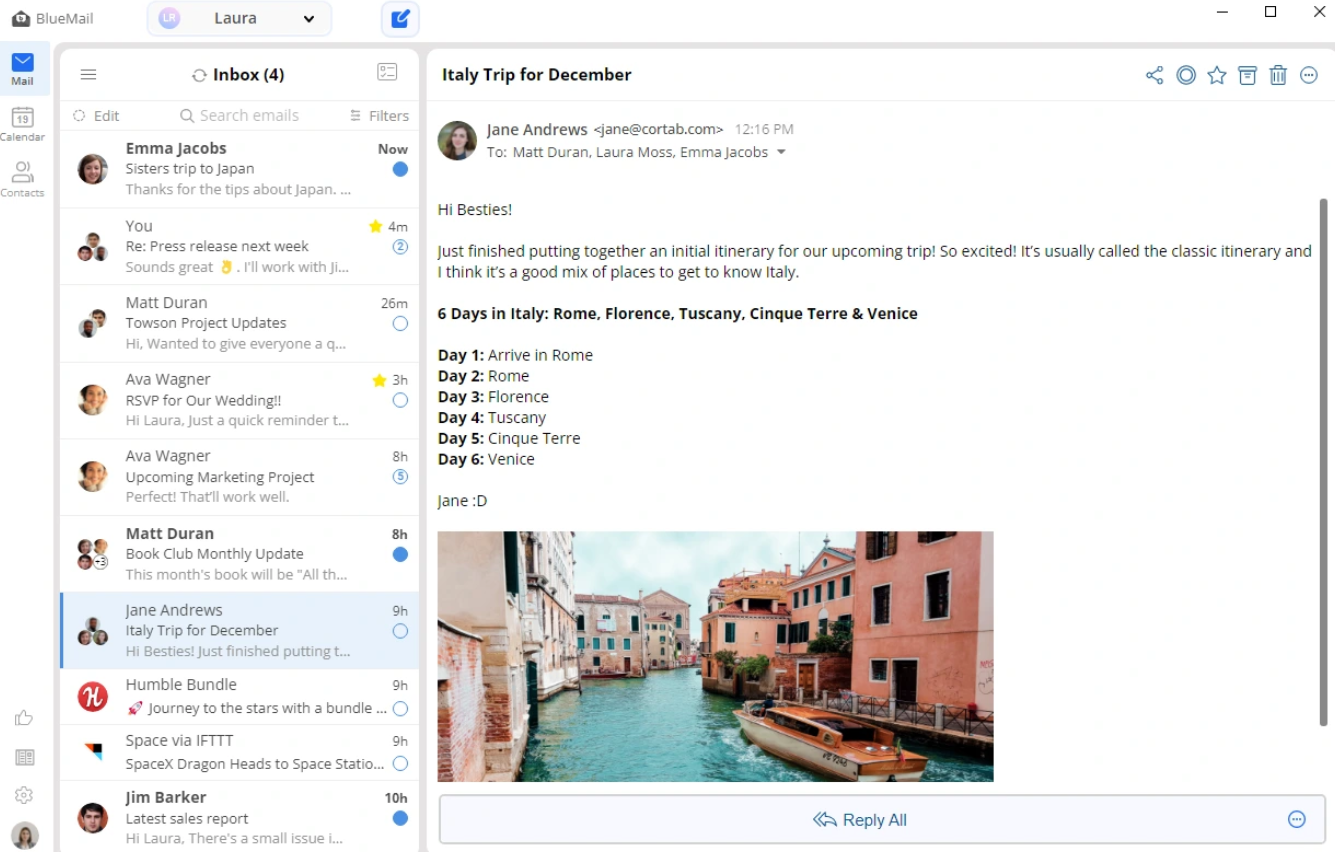
BlueMail, made by Blix Inc., is a free email app for Android, iPhone, Mac, Windows and Linux with more than 10 million downloads on Google Play. The free plan covers unlimited accounts with no ads, a unified inbox, Clusters that group mail from the same senders, a calendar and PGP encryption. The paid Plus plan ($36 a year when billed annually) adds GemAI for writing and summaries.
It's still actively updated, so if you're asking whether BlueMail has stopped working, the app itself hasn't. People switch for other reasons:
- A crowded interface with a lot of menus and options.
- Sync and notification problems with some accounts, which come up regularly in user forums.
- Wanting a smaller, open-source app on Android.
- AI is only on the paid plan, and S/MIME only on Enterprise.
BlueMail alternatives compared
| App | Best for | Runs on | Free plan | Paid price |
|---|---|---|---|---|
| Canary Mail | AI and encryption on phone and computer | Android, iPhone, iPad, Mac, Windows | Unlimited accounts, 2 devices | Growth $36/year; Pro+ $100/year |
| Thunderbird for Android | Free and open source | Android (desktop: Windows, Mac, Linux) | Free | None (donations) |
| FairEmail | Privacy and fine control | Android | Almost everything, no ads | One-time Pro purchase |
| Gmail | Zero setup | Android, iPhone, web | Yes, with ads | Google One for storage |
| Microsoft Outlook | Exchange and Microsoft 365 | Android, iPhone, Windows, Mac, web | Yes, with ads | Microsoft 365 plans |
| Dove (ours) | An AI-first inbox | Android, iPhone, Mac, Windows, web | 10 AI actions a day | $20/month or $200/year |
| Spark | A sorted inbox and small teams | Android, iPhone, iPad, Mac, Windows | Unlimited accounts | Plus $99/year; Pro $199/year |
| Aqua Mail | Customization | Android, iPhone | Yes, with ads | Premium $9.99/month or one-time |
The 8 best BlueMail alternatives in 2026
1. Canary Mail: Best for AI and encryption on phone and computer
Disclosure: we make Canary Mail.
Canary matches BlueMail's reach on Android, iPhone, iPad, Mac and Windows and works with Gmail, Outlook and Microsoft 365, Exchange, iCloud, Yahoo and any IMAP account. AI sorts your inbox on every plan, including the free one, which BlueMail keeps behind Plus. Growth adds AI writing and summaries, read receipts and send later, and Pro+ adds PGP, SecureSend and phishing and impersonation detection. Tracker blocking is on by default, triage runs on your device, and your email isn't used to train AI. More than 2 million people use it.
- Who it's for: BlueMail users who want a cleaner app with AI and encryption
- Price: free for unlimited accounts on 2 devices; Growth $36/year; Pro+ $100/year; lifetime licenses $100 and $300
- Platforms: Android, iPhone, iPad, Mac, Windows
- Downside: no Linux version, AI writing and encryption are on paid plans, there's no monthly option, and the calendar isn't on Android.
2. Thunderbird for Android: Best free, open-source app
Thunderbird for Android is the former K-9 Mail, now developed by the Thunderbird team. It's free, open source, has no ads, connects straight to your provider, and offers a unified inbox and OpenPGP encryption through the OpenKeychain app. Pair it with Thunderbird on Windows, Mac or Linux and you cover BlueMail's desktop side too.
- Who it's for: people who want a simple, free app that doesn't track them
- Price: free
- Platforms: Android; desktop Thunderbird on Windows, Mac and Linux; an iPhone app in public beta on TestFlight
- Downside: no calendar and no Exchange ActiveSync on Android, and fewer features than BlueMail.
3. FairEmail: Best for privacy and fine control on Android
FairEmail is open source, has no ads or analytics, and stores nothing on third-party servers. It supports unlimited accounts and addresses, OpenPGP and S/MIME, and tries to block tracking images. Pro, a one-time purchase, adds snooze, send later, filter rules and widgets.
- Who it's for: privacy-minded Android users who like to tweak settings
- Price: free; Pro is a one-time purchase in Google Play
- Platforms: Android
- Downside: it looks plain, has a learning curve, and doesn't support Exchange ActiveSync.
4. Gmail: Best zero-setup option
Gmail is already on most Android phones and can add Outlook, Yahoo, iCloud and IMAP accounts next to your Google ones, with an All inboxes view.
- Who it's for: people with mostly Google accounts who want something simple
- Price: free; Google One adds storage
- Platforms: Android, iPhone, web
- Downside: non-Google accounts miss out on Gmail's categories and spam filtering, and personal accounts show ads.
5. Microsoft Outlook: Best for Exchange and Microsoft 365
Outlook is free on Android, has Focused Inbox and a full calendar, and adds Gmail, Yahoo, iCloud and IMAP accounts. For a work Microsoft 365 account it's the app your IT team will expect.
- Who it's for: anyone whose main account is Microsoft
- Price: free with ads; Microsoft 365 plans remove ads for Outlook.com addresses
- Platforms: Android, iPhone, Windows, Mac, web
- Downside: non-Microsoft accounts sync through Microsoft's cloud, and the free version shows ads.
More: Outlook alternatives.
6. Dove: Best AI-first inbox
Dove is made by the team behind Canary Mail. It sorts mail into what needs you and what can wait, drafts replies, and gives you a daily summary of your inbox. It works with Gmail, Microsoft and IMAP accounts on phone, desktop and web.
- Who it's for: people who want AI to do the sorting and first drafts
- Price: free with 10 AI actions a day; Pro $20/month or $200/year
- Platforms: Android, iPhone, Mac, Windows, web
- Downside: it's new, with a small Android user base so far, and the free AI is capped at 10 actions a day.
7. Spark: Best for a sorted inbox and small teams
Spark's Smart Inbox and Gatekeeper do the same kind of job as BlueMail's Clusters and people view, with a calmer design. Paid plans add AI writing and team features like shared drafts and comments.
- Who it's for: people who want a tidy inbox on phone and computer, and small teams
- Price: free for unlimited accounts; Plus $10/month or $99/year; Pro $20/month or $199/year, per user
- Platforms: Android, iPhone, iPad, Mac, Windows
- Downside: some mail is processed on Readdle's servers, there's no Linux app, and AI is on paid plans.
More: Canary Mail vs Spark.
8. Aqua Mail: Best for customization
Aqua Mail has hundreds of settings, widgets and Wear OS support, and handles Exchange, Microsoft 365 and IMAP. It isn't cloud-based, so your passwords and mail stay on the phone.
- Who it's for: Android users who want to tune every detail
- Price: free with ads; Premium $9.99/month on Aqua's site, or a one-time license
- Platforms: Android, iPhone
- Downside: the free version shows ads and is limited, and there's no desktop app.
More: Aqua Mail alternatives.
BlueMail vs Apple Mail and Canary Mail
BlueMail vs Apple Mail: on an iPhone, iPad or Mac, Apple Mail is free, already installed and has categories, send later and undo send. BlueMail adds Clusters, a people view and PGP, and runs on Android, Windows and Linux, which Apple Mail doesn't. If you only use Apple devices, Apple Mail is usually enough; see Apple Mail alternatives if it isn't.
BlueMail vs Canary Mail: both have free plans with unlimited accounts and PGP. BlueMail also runs on Linux and its free plan has no device limit; Canary's free plan covers 2 devices but includes AI inbox sorting, and its paid plans add AI writing, read receipts and phishing detection. We make Canary, so weigh that.
Is BlueMail safe, and is it open source?
BlueMail isn't open source; it's a closed-source app from Blix. On Android it says it talks to your provider directly rather than through a proxy server, offers PGP with keys kept on your device, and supports OAuth sign-in for major providers. Some privacy-minded users still prefer open-source apps they can inspect, such as Thunderbird for Android and FairEmail. For more, see the best secure email apps.
How to switch from BlueMail
BlueMail doesn't hold your mail; it reads it from Gmail, Outlook, Yahoo or your IMAP server. Add the same accounts to the new app and your mail appears. Copy signatures by hand, and if you use PGP, make sure you have a copy of your key before you remove the app. Then sign out of BlueMail and revoke its access in your Google or Microsoft account security settings. For more Android options, see the best email apps for Android.
Frequently asked questions
What is the best BlueMail alternative for Android?
Thunderbird for Android or FairEmail if you want free and open source; Gmail or Outlook for zero setup; Canary Mail (ours) or Spark if you want AI and the same app on your computer.
Has BlueMail stopped working?
No. BlueMail is still on Google Play and the App Store and was updated in October 2026. If it stops syncing, remove and re-add the account, or check your provider's status page.
Is BlueMail free?
Yes. The Personal plan is free for unlimited accounts with no ads. Plus adds GemAI and costs $36 a year when billed annually.
Is BlueMail open source?
No. Open-source alternatives include Thunderbird for Android, FairEmail and, on the desktop, Thunderbird.
What is the best email app for Android in 2026?
It depends on your accounts. Our guide to the best email apps for Android compares ten, from Gmail and Outlook to Canary Mail and Thunderbird.
Which BlueMail alternative works on Linux?
Thunderbird is the most complete desktop email client on Linux. Mailspring is another free option.